Open Monday - Friday 08.30 – 17.30 | Call Center 02 101 4427

Hybrid Simulation: Full Vehicle HSRC

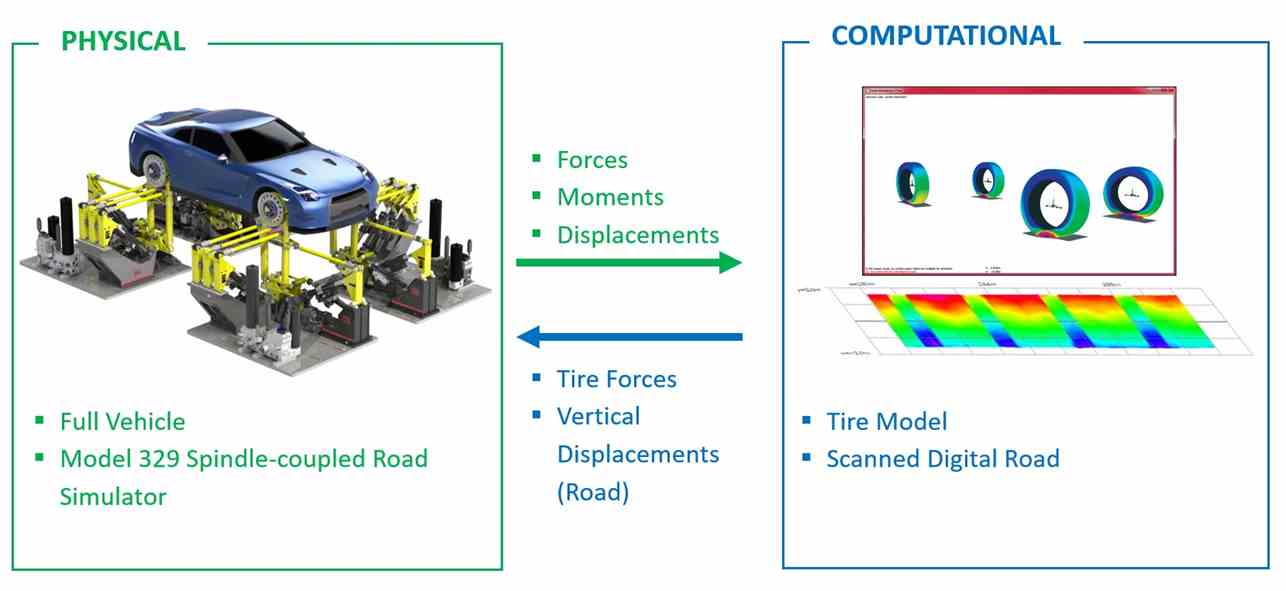
Hybrid Simulation Repsponse Convergence (HSRC) combines virtual tires and digital scanned road surfaces with a physical vehicle on a standard 329 road simulator to create highly accurate road load simulations. The iterative HSRC technique can be used to generate full-vehicle durability test loads efficiently in the lab without having to drive instrumented prototypes over proving grounds.

  • Durability Test Load Generation
  • Full Vehicle
true
true

KEY PRODUCT FEATURES

Accelerated Testing

Lab-based HSRC compresses vehicle development schedules by replacing time-consuming, conventional proving ground Road Load Data Acquisition (RLDA)

Innovative Technology

MTS continues to pioneer new ways of integrating physical components under test and computational models to realize new efficiencies and reduce costs and time to market

Cost Efficient

The Iterative HSRC technique can be performed with a standard Model 329 Road Simulator and FlexTest controls - no special real-time capabilities required

Unmatched Expertise

MTS Staff and R&D engineers are actively engaged with industry partners worldwide, proving the utility and effectiveness of numerous iterative and real-time hybrid simulation approaches

TECHNICAL OVERVIEW

Hybrid System Response Convergence (HSRC) is an iterative technique developed by MTS that makes hybrid simulation practical for more complex, high-bandwidth applications where the use of a sequential, offline iterative technique is necessary.

Durability Test Load Generation

This application of the HSRC technique combines a simulator-mounted test vehicle with virtual tires and scanned digital road surfaces to create a digital, three-dimensional proving ground over which the test vehicles can be “driven” to simulate braking and maneuvering events.

  • RPC iteration processes coordinate the dynamics between the physical and virtual systems to find a force and motion solution that satisfies both simultaneously.
  • Sequential iterations yield test drive files that have proven to correlate well with actual road load measurements
  • Eliminates need for a prototype, a proving ground or a comprehensive digital model 
  • Enable the generation of accurate durability test road loads without an instrumented prototype, a proving ground or a comprehensive digital model 
  • Iterative process does not require the system components to be operated in real time; works with standard test systems and existing vehicle models